


Hey there! I'm a supplier of Plastic Preform Molds, and today I wanna chat about the challenges in PET plastic preform molding. It's a field that's both fascinating and full of hurdles, and I've seen my fair share of them over the years.
1. Material-Related Challenges
First off, let's talk about the PET material itself. PET, or polyethylene terephthalate, is a commonly used plastic for preforms, but it comes with its own set of issues. One major challenge is moisture absorption. PET has a tendency to absorb moisture from the air, and if this moisture isn't properly removed before molding, it can lead to some serious problems. When the moist PET is heated during the molding process, the water turns into steam. This steam can cause bubbles or voids in the preform, weakening its structure and affecting its appearance.
To combat this, we need to dry the PET resin thoroughly. But here's the catch - over - drying can also be a problem. If the resin is dried for too long or at too high a temperature, it can start to degrade, which changes its properties and makes it harder to mold properly. So, finding that sweet spot for drying is crucial.
Another material - related challenge is the viscosity of the PET. The viscosity can vary depending on factors like the resin's molecular weight and the temperature during molding. If the viscosity is too high, the molten PET may not flow evenly into the mold cavities, resulting in incomplete filling or uneven wall thickness in the preforms. On the other hand, if the viscosity is too low, it can lead to flash, which is excess plastic that forms around the edges of the preform. Controlling the viscosity requires precise temperature control and a good understanding of the resin's characteristics.
2. Mold Design and Manufacturing Challenges
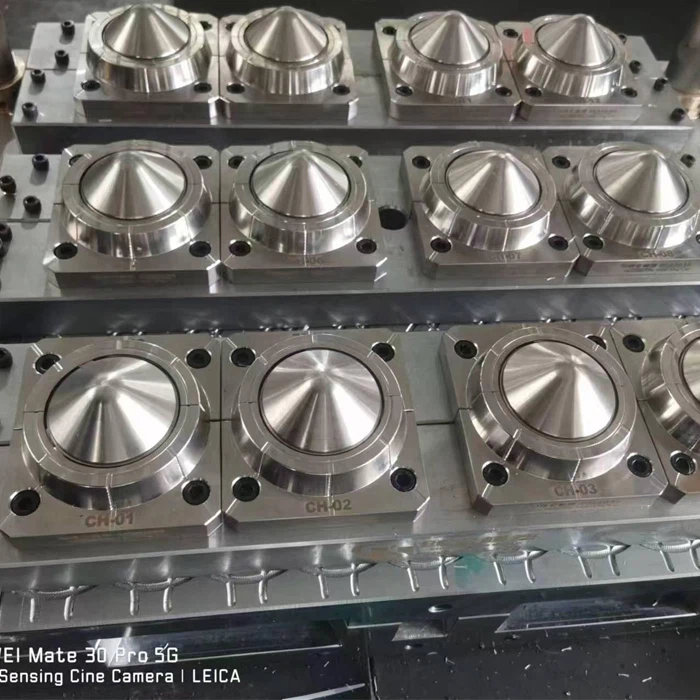
The design and manufacturing of the preform mold are also key areas where challenges arise. One of the main issues is achieving uniform cooling. In a multi - cavity mold, like our 16 Cavity Preform Mold or 48 Cavity Preform Mold, each cavity needs to be cooled evenly. If one cavity cools faster than the others, the preforms in that cavity will shrink at a different rate, leading to variations in size and shape. This can cause problems during the subsequent blow - molding process, where the preforms are turned into final products like bottles.
Mold manufacturing also has its own set of difficulties. The mold cavities need to be machined with extremely high precision. Even the slightest deviation in the dimensions of the cavity can result in preforms that don't meet the required specifications. For example, if the neck finish of the preform is not machined accurately, it can cause sealing problems when the final product is capped.
Moreover, the mold needs to be made from high - quality materials that can withstand the high pressures and temperatures involved in the molding process. If the mold material is not durable enough, it can wear out quickly, leading to increased production costs and downtime for mold replacement.
3. Process Control Challenges
Controlling the molding process is a complex task. One of the most important factors is the injection speed. If the injection speed is too fast, it can cause the molten PET to splash or create air pockets in the mold. This can lead to surface defects on the preform, such as streaks or blisters. On the other hand, if the injection speed is too slow, the PET may start to cool before it fills the entire mold cavity, resulting in incomplete preforms.
The holding pressure is another critical parameter. After the mold is filled with molten PET, a holding pressure is applied to ensure that the plastic takes the shape of the mold and to compensate for shrinkage as it cools. If the holding pressure is too low, the preform may shrink too much, causing dimensional variations. If it's too high, it can lead to excessive stress in the preform, which can make it more prone to cracking.
Temperature control is also vital throughout the process. The barrel temperature, where the PET is melted, needs to be carefully regulated. If the temperature is too low, the PET may not melt completely, leading to poor flow and incomplete filling. If the temperature is too high, the PET can degrade, as mentioned earlier. Additionally, the mold temperature needs to be maintained at an optimal level to ensure proper cooling and solidification of the preform.
4. Quality Control Challenges
Ensuring the quality of the preforms is a continuous challenge. Visual inspection is one of the primary methods, but it can be time - consuming and prone to human error. Even with trained operators, it's possible to miss small defects. Some defects, like internal voids or stress cracks, may not be visible to the naked eye.
To overcome this, we use more advanced inspection techniques such as X - ray inspection or ultrasonic testing. However, these methods can be expensive and require specialized equipment and trained personnel.
Another aspect of quality control is ensuring that the preforms meet the required mechanical properties. For example, the preforms need to have sufficient strength to withstand the blow - molding process and the subsequent handling and storage of the final products. Testing the mechanical properties, such as tensile strength and impact resistance, requires specialized testing equipment and can be a complex and time - consuming process.
5. Environmental and Regulatory Challenges
In today's world, environmental concerns are becoming increasingly important. PET is a recyclable plastic, but the molding process itself can have an environmental impact. The energy consumption during the melting and molding process is significant. Reducing this energy consumption is a challenge, but it's also necessary to meet environmental regulations and to reduce production costs.
There are also regulatory requirements that need to be met. For example, the preforms used in food and beverage packaging need to comply with strict safety standards. These standards ensure that the plastic does not leach any harmful substances into the contents of the package. Meeting these regulations requires careful selection of raw materials and strict quality control throughout the production process.
Conclusion
As you can see, PET plastic preform molding is a complex process with many challenges. But at our company, we're constantly working to overcome these challenges. We invest in research and development to improve our mold design, optimize our manufacturing processes, and enhance our quality control methods.

If you're in the market for high - quality preform molds, whether it's a Jar Preform Mold or a multi - cavity mold, we'd love to have a chat with you. We have the expertise and experience to provide you with the best solutions for your preform molding needs. So, don't hesitate to reach out and start a conversation about your requirements. We're here to help you succeed in your business.
References
- "Plastics Processing: Principles and Modeling" by Z. Tadmor and C. G. Gogos
- "Molding of Thermoplastic Materials" by James L. Throne
- Industry reports on PET plastic molding from various research institutions


